
Back to blog
How to Be a Better Boyfriend: A Practical Checklist
Key takeaways
- A better boyfriend is consistent, emotionally safe, curious, accountable, and proactive in ordinary moments, not performative only after something goes wrong.
- The clearest signal is usually the repeated pattern, not one good day or one bad conversation.
- Repair works best when both people can name the pattern and change one visible habit.
- Use the next step to create structure, not to chase reassurance.
A better boyfriend is consistent, emotionally safe, curious, accountable, and proactive in ordinary moments, not performative only after something goes wrong.
How to be a better boyfriend: the short answer

If you want to know how to be a better boyfriend, start with the part that is less glamorous than romance: become easier to trust in ordinary moments.
A better boyfriend is consistent, emotionally safe, curious, accountable, and proactive. He does not only become thoughtful after a fight. He does not only listen when the relationship is at risk. He does not need his girlfriend to manage every plan, every mood, every repair, and every conversation before he shows up.
That does not mean becoming perfect. It means becoming more reliable with the parts of love that repeat.
You answer clearly. You make plans with follow-through. You notice bids for connection. You apologize without turning the apology into a defense. You stay interested in her inner life after the early chemistry becomes familiar. You keep growing without making your improvement a performance she has to praise every week.
The checklist below is practical because relationships are practical. Love is not only what you feel. It is what your partner can safely expect from you.
Start by becoming easier to trust
Trust is not built only by being loyal in the obvious ways.
It is built when your words and behavior start matching in small ways.
You say you will call, and you call. You say you want to plan something, and you actually pick a time. You say her feelings matter, and then you do not mock, minimize, or disappear when those feelings are inconvenient.
The Gottman Institute describes small attempts for attention, affection, or support as bids for connection. Their guidance on emotional bids and trust is useful here because being a better partner is often less about one heroic gesture and more about how often you turn toward the small moment.
If she tells you a small story and you keep scrolling, that is a moment.
If she says she had a hard day and you immediately fix, debate, or compare, that is a moment.
If she reaches for closeness and you respond with warmth instead of irritation, that is also a moment.
A better boyfriend learns to treat those small moments as the relationship, not as interruptions to the relationship.
The better boyfriend checklist

Use this as a self-audit, not as a personality test.
1. Make consistency visible

Consistency is not boring. It is what lets romance relax.
If your girlfriend never knows whether you will answer, follow through, show up on time, or care tomorrow about what you said yesterday, she has to stay emotionally alert around you. That kind of alertness can start looking like neediness, but often it is a response to unpredictability.
Start with visible consistency.
- Confirm plans instead of leaving them vague.
- Text if timing changes.
- Follow through on small promises.
- Keep affection steady when you are stressed.
- Do not make her ask three times for something you already agreed mattered.
You do not need to become rigid. You need to become believable.
2. Listen without preparing your defense
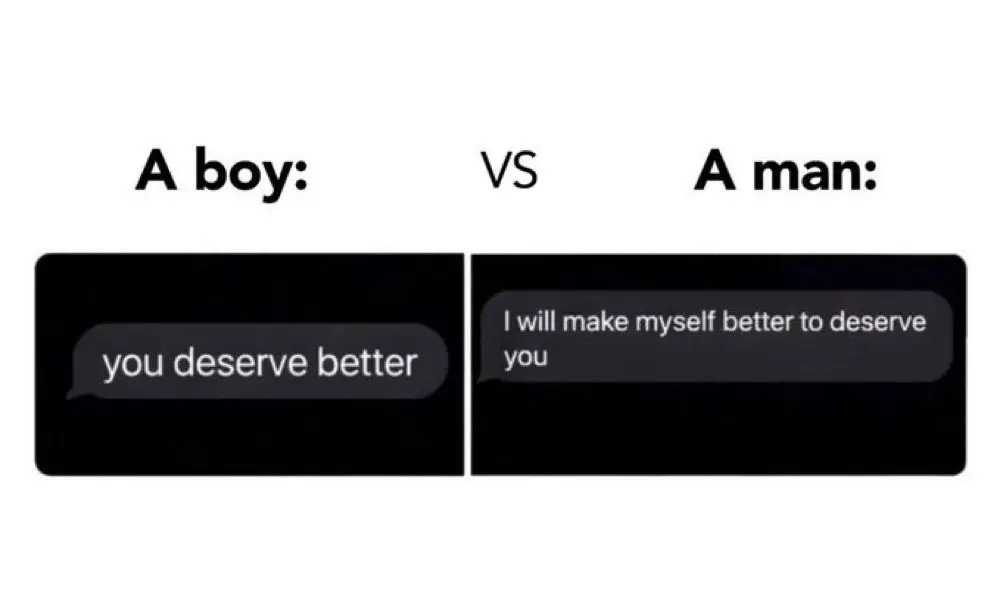
A lot of men think they are listening because they are quiet while their partner talks.
But real listening is not waiting for your turn to explain.
Try this instead:
"I hear that when I canceled late, it made you feel like your time did not matter. I can understand why that hurt."
That sentence does not mean you are admitting to being a terrible person. It means you are strong enough to understand impact before arguing intention.
Listening gets better when you ask one more question:
"What part of that felt the worst?"
"What would have helped in that moment?"
"Do you want me to listen, help solve it, or just stay close right now?"
If you want a deeper structure for these conversations, pair this with relationship check-in questions. A weekly check-in makes listening a practice instead of a crisis response.
3. Learn how to repair after you miss

You will miss things.
You will say something too sharply. You will get distracted. You will forget something that mattered. You will misunderstand the point. You will become defensive when you should have stayed curious.
The question is not whether you ever mess up. The question is what happens after.
A useful apology has three parts:
- Name what you did.
- Name the effect it had.
- Name what you will do differently next time.
Try:
"I got defensive when you were trying to tell me you felt alone. That probably made it harder for you to be honest with me. Next time I want to pause and ask what you need before I explain myself."
That is repair. Not begging. Not self-hatred. Not a speech about how stressed you were. Repair is ownership that makes the next moment safer.
For a fuller guide, read how to repair a relationship.
4. Be proactive about plans and emotional labor
If she has to plan every date, remember every conversation, notice every distance, and initiate every repair, she may start feeling less like your partner and more like the relationship manager.
Being a better boyfriend means taking some of that invisible labor seriously.
Plan the date sometimes.
Remember the thing she said was important.
Ask about the appointment, the friend conflict, the work stress, the family issue, the dream she mentioned once and then stopped mentioning because nobody asked.
Do not wait until she is disappointed to become thoughtful.
Proactive care sounds like:
"I booked dinner for Friday. Does 7 work?"
"You said this week was going to be heavy. What would make tonight easier?"
"I know we have both been busy. Can we take a walk tomorrow and actually catch up?"
Small initiative can change the whole emotional climate of a relationship.
5. Protect emotional safety during conflict
A better boyfriend does not need to win every hard conversation.
He needs to keep the relationship safe enough that both people can tell the truth.
The Gottman Institute's work on the Four Horsemen names destructive conflict patterns like criticism, contempt, defensiveness, and stonewalling. You do not need to memorize the whole framework to use the basic lesson: the way you fight becomes part of what your partner learns to expect from love.
Do not use sarcasm to punish vulnerability.
Do not disappear for hours to make a point.
Do not turn every concern into evidence that she is too sensitive.
Do not keep score so carefully that there is no room for softness.
When the conversation starts speeding up, try:
"I am starting to defend myself instead of listening. I want to pause for ten minutes and come back."
"I do not want to win this and make us feel farther away."
"Can we slow down and name what we are actually trying to protect?"
That is not weakness. It is leadership inside the relationship.
6. Support her boundaries without making them about your ego
If she says she needs a night alone, a clearer plan, more respectful communication, or less pressure around something, do not immediately treat the boundary as rejection.
Ask what the boundary is protecting.
Healthy boundaries are not always walls. Sometimes they are instructions for how love can stay safe.
Try:
"I can respect that. Is there anything you want me to understand about why this matters?"
"Thank you for telling me clearly. I do not want you to have to over-explain it."
"I may need a minute with my feelings, but I can still respect the boundary."
That last sentence is important. You are allowed to have feelings. You are not allowed to make her responsible for removing the boundary so you do not have to feel them.
7. Stay interested after the relationship feels familiar
Early dating creates curiosity automatically. Long-term care requires choosing curiosity on purpose.
Ask better questions.
Not only, "How was your day?"
Try:
"What has been taking up the most space in your mind lately?"
"What do you wish I understood better about this season of your life?"
"Where have you felt supported by me recently, and where have you felt alone?"
"What would make us feel more like a team this month?"
That kind of curiosity keeps your partner from becoming a role in your life instead of a person you keep learning.
If this is the area you want to build, what intimacy in a relationship means goes deeper into emotional closeness, trust, repair, attention, play, and physical connection.
8. Keep your own life emotionally healthy
Being a better boyfriend is not only about what you do for her.
It is also about how responsibly you handle yourself.
If your girlfriend becomes your only emotional outlet, only source of reassurance, only planner, only motivation, and only place where your feelings go, the relationship can become heavy quickly. Partnership is intimate, but it is not supposed to replace your whole support system.
Maintain friendships. Handle your health. Keep promises to yourself. Learn your stress patterns. Notice when you withdraw, snap, numb out, or pretend everything is fine.
Harvard Health's guidance on fostering healthy relationships points to patterns like respect, feeling valued, communication, and boundaries. That applies to romantic love too: the healthier your own patterns become, the less your partner has to carry for both of you.
Scripts that make you a better partner
Use these when you need language and your nervous system wants to improvise badly.
When she is upset
"I want to understand before I respond. What did that feel like from your side?"
When you need to apologize
"I can see why that hurt. I was focused on my intention, but the impact was different. I am sorry. Next time I will..."
When plans are vague
"I want to make this easy to count on. Does Friday at 7 work, or should I pick another time?"
When conflict gets tense
"I care more about us feeling safe than about winning this point. Can we slow down?"
When she sets a boundary
"I respect that. I might need to process my own feelings, but I will not argue with your boundary."
When you want feedback
"What is one small thing I could do this week that would make you feel more supported?"
The point is not to memorize perfect lines. The point is to become the kind of person who reaches for clarity instead of avoidance.
Signs you are becoming a better boyfriend
You may already be improving if these signs are starting to show up:
- She brings up small things earlier because she trusts you not to punish the conversation.
- You notice yourself pausing before defending.
- You follow through on ordinary promises without needing applause.
- Conflict repairs faster because you are less interested in winning.
- You ask more specific questions and remember the answers.
- She seems softer around you, not smaller.
- You can hear feedback without turning it into a crisis about your worth.
- You are more consistent when you are stressed, tired, or busy.
The best sign is not that she never gets upset.
The best sign is that the relationship has more room for honesty, repair, and ordinary warmth.
Nice-guy mistakes that do not actually help
Trying to be a better boyfriend can turn strange if you make it about being seen as good.
Avoid these mistakes.
Performing improvement for praise
If you do one thoughtful thing and then wait for her to reassure you that you are amazing, you have turned care into a transaction.
Let good behavior become normal.
Agreeing to everything and resenting it later
People-pleasing is not emotional maturity. If you say yes while secretly collecting resentment, the relationship will feel peaceful only on the surface.
Be kind and honest.
Treating basic respect like a gift
Not cheating, not yelling, not humiliating her, and answering clearly are not luxury traits. They are baseline. If you need this distinction, read the bare minimum in a relationship.
Trying to fix every feeling
Sometimes support means problem-solving. Sometimes it means listening. Sometimes it means sitting beside her while the feeling moves through.
Ask which one she wants.
Becoming intense for one week and then disappearing
One dramatic improvement sprint will not rebuild trust if your normal pattern returns immediately after.
Go smaller. Repeat longer.
How to keep improving without turning love into a performance
Choose one habit at a time.
For one week, practice follow-through.
For the next week, practice listening without defending.
Then practice repair.
Then proactive planning.
Trying to fix every part of yourself at once can make the relationship feel like a project. Your girlfriend does not need you to become a different person by Friday. She needs to see that your care can become more consistent, more thoughtful, and more emotionally safe over time.
If your relationship has already become distant, start with relationship repair after distance. If you want a warmer everyday affection idea, read cute names to call your boyfriend. If you want one low-pressure note each week about dating, repair, and emotional clarity, the CalebMerridan newsletter is a useful next step.
FAQ
What makes someone a better boyfriend?
A better boyfriend is consistent, emotionally safe, curious, accountable, and proactive. He listens without rushing to defend himself, follows through on ordinary promises, repairs after conflict, and keeps showing interest after the relationship feels familiar.
How can I be a better boyfriend to my girlfriend?
Start with one visible behavior this week: make a clear plan, ask a real follow-up question, apologize cleanly for one recent miss, or take responsibility for a small task she usually carries. Improvement becomes believable when it shows up in behavior.
What are signs I am becoming a better partner?
You are becoming a better partner when feedback feels less threatening, repair happens faster, your partner does not have to chase basic follow-through, and the relationship has more honesty without more fear.
Can I be a better boyfriend if I have been defensive before?
Yes, if you stop treating defensiveness as your personality and start treating it as a pattern you can interrupt. Begin by pausing, reflecting back what you heard, and asking what impact your behavior had before you explain your intention.
A final note
Becoming a better boyfriend is less about one grand romantic gesture and more about repeatable repair, communication, and emotional safety.
Related Articles

Why Do People Break Up? Common Reasons Relationships End

Anniversary Ideas for Couples: 43 Meaningful Ways to Celebrate

What Is a Talking Stage? Meaning, Signs, and When to Move On

How to Set Healthy Boundaries in Relationships Without Pushing Love Away

Dating App Statistics 2026: What the Numbers Say About Modern Dating

My Girlfriend Is My Best Friend: Healthy Sign or Too Much?