
Deep Question Randomizer
Draw a small set of questions from a larger pool while filtering by category and intensity.
Start Playing in 3 Steps
Open the game, follow the prompts, and use the final card or result as the conversation starter.
- 1
Choose intensity
Pick the depth level or let the randomizer choose.
- 2
Draw a mini-deck
Answer one card at a time without repeating the whole pool.
- 3
Redraw with care
Redraw when the mood is wrong, not just when the question is honest.
Question Pool
What tiny habit do you want us to keep?
What topic have we been avoiding?
What do you wish I noticed faster?
What should our next date feel like?
Where do we read each other well?
What do you need from me when you are quiet, but not upset?
What did you learn about love before you met me that you are still unlearning?
Which part of our ordinary routine feels most like us?
What future conversation would feel easier if we started it gently now?
What is Deep Question Randomizer?
Deep Question Randomizer is a relationship game for people who want to draw a fresh mini-deck from a larger deep-question pool without repeating the same cards.
Draw a small set of questions from a larger pool while filtering by category and intensity.
The game is built around real playable content such as "What made you feel close to me recently? (closeness, soft)", "What tiny habit do you want us to keep? (habits, soft)", "What topic have we been avoiding? (repair, bold)", and "What do you wish I noticed faster? (understanding, medium)". Those examples give the page more than a generic relationship prompt because they show the exact kind of choice, question, clue, score, or challenge the player will meet.
Deep Question Randomizer is best for 2 players who want a 5-12 min interaction with large pool, intensity filter, and no-repeat draw.
Why it works for couples
The format works because it makes draw a fresh mini-deck from a larger deep-question pool without repeating the same cards easier to approach through play.
Instead of asking for a serious explanation first, the game starts with a concrete move: Pick the depth level or let the randomizer choose., Answer one card at a time without repeating the whole pool., and Redraw when the mood is wrong, not just when the question is honest.. That lowers pressure and gives both people something specific to respond to.
The content is narrow enough to create useful conversation. A card like "What made you feel close to me recently? (closeness, soft)", "What tiny habit do you want us to keep? (habits, soft)", "What topic have we been avoiding? (repair, bold)", and "What do you wish I noticed faster? (understanding, medium)" points to a real preference, boundary, attraction cue, repair need, date idea, or social read instead of leaving the couple with a vague topic.
Because the interaction has a reveal, result, vote, score, winner, draw, or follow-up, the conversation has a natural second step. Players can talk about why the answer fit, what surprised them, and what they would do differently next time.
How the gameplay works
Deep Question Randomizer uses a generator format, so the player does not have to invent the structure from scratch.
The basic flow is: Choose intensity: Pick the depth level or let the randomizer choose. Draw a mini-deck: Answer one card at a time without repeating the whole pool. Redraw with care: Redraw when the mood is wrong, not just when the question is honest.
The current game includes 4 representative content examples in this guide, and the playable deck itself contains enough rounds to replay without feeling like the same prompt is doing all the work.
The interface keeps the action small. You answer, choose, rate, spin, draw, vote, or follow a branch, then use the on-screen result or prompt to decide what the moment means.
How to use the generated result
The generated result is a starting point that reduces decision friction, not an order you have to follow exactly.
If the first idea fits the mood, make it concrete with a time, place, and smallest first step. If it is close but not quite right, adjust the energy, cost, or setting.
The value is momentum. A generated idea can be useful even when you change it, because it gives both people something specific to react to.
When to play
Play Deep Question Randomizer when the relationship needs a specific starting point more than another broad talk about feelings.
It fits conversation moments: date nights, quiet couch nights, long-distance calls, group hangs, low-energy weekends, or the moment when both people want connection but do not know how to begin.
Keep the tone curious. If the game reveals a real boundary, a strong reaction, or a repeated pattern, pause the game long enough to treat that answer with care.
Because the expected session is 5-12 min, it can work as a quick opener or as the first step into a longer conversation.
What you can take away
The useful outcome is not only finishing Deep Question Randomizer. It is leaving with clearer language for the choice, pattern, or preference the game surfaced.
Draw a fresh mini-deck without repeating the same question twice. That one-line payoff should become something practical: a question to ask, a plan to try, a boundary to name, or a detail to remember next time.
- Draw a fresh mini-deck from a larger deep-question pool without repeating the same cards.
- Draw a fresh mini-deck without repeating the same question twice.
- A clearer read on large pool, intensity filter, and no-repeat draw.
How it compares with ordinary question pages
Caleb Merridan Games turn relationship experience into playable choices, reveals, results, and next-step prompts. You still get conversation starters, but the interaction gives both people more to react to than a static list.
Static prompts can start a conversation. The game adds choices, reveal moments, and a clearer next step.
How you start
Read a list of questions and pick one to discuss.
Interactive
Make a small choice together so the conversation begins naturally.
What you compare
Mostly the answers you say out loud.
Interactive
Choices, reasons, surprises, and the pattern behind the result.
What the result means
Usually no result, or a simple score without much context.
Interactive
A generated prompt or date idea that gives the couple a practical next step instead of another list to browse.
Pressure level
Can feel like a serious talk if the question is direct.
Interactive
Lighter than a formal check-in, but more useful than scrolling for prompts.
| What changes | Static question list | Interactive |
|---|---|---|
| How you start | Read a list of questions and pick one to discuss. | Make a small choice together so the conversation begins naturally. |
| What you compare | Mostly the answers you say out loud. | Choices, reasons, surprises, and the pattern behind the result. |
| What the result means | Usually no result, or a simple score without much context. | A generated prompt or date idea that gives the couple a practical next step instead of another list to browse. |
| Pressure level | Can feel like a serious talk if the question is direct. | Lighter than a formal check-in, but more useful than scrolling for prompts. |
Who Caleb Merridan is for
Most relationship confusion does not need a verdict from a relationship coach who barely knows you. Caleb Merridan gives you private tools to slow down, see the pattern, and choose your next step yourself.

New couples building closeness
For people who want an easy way to learn each other's habits, preferences, and small emotional details before the relationship feels too serious.

Long-distance or stuck conversations
For couples who need a lighter way to restart a call, check in after distance, or move past the same conversation loop.

Singles reading relationship signals
For people in a crush, situationship, or early dating stage who want to notice patterns without spiraling over one message.
Why I built Caleb Merridan
I started with relationship advice.
At first, I thought people needed sharper answers. Is this a red flag? Does he care? Should I stay patient, say something, pull back, or finally stop explaining?
But after seeing the same questions again and again, I started to notice something else.
Most people were not looking for someone to take over their love life. They were looking for a way to think clearly before they made the next move.
Formal counseling can be valuable, but a lot of people are not ready for it. It can feel too expensive, too serious, too exposed, or simply too far away from the small moments where confusion actually happens.
And many people do not want another stranger giving them a verdict.
They want privacy. They want language. They want a way to look at the pattern without being pushed into a performance of healing.
That is why Caleb Merridan became more than articles.
I wanted to build a place where relationship questions could become small, usable tools: a quiz that names the pattern, a game that helps two people compare answers, a guide that gives words to something hard to say.
Not consulting. Not a diagnosis. Not a dramatic answer.
Just a calmer way to understand what is happening, and one useful next step you can actually take.

Ideas People Kept Coming Back To
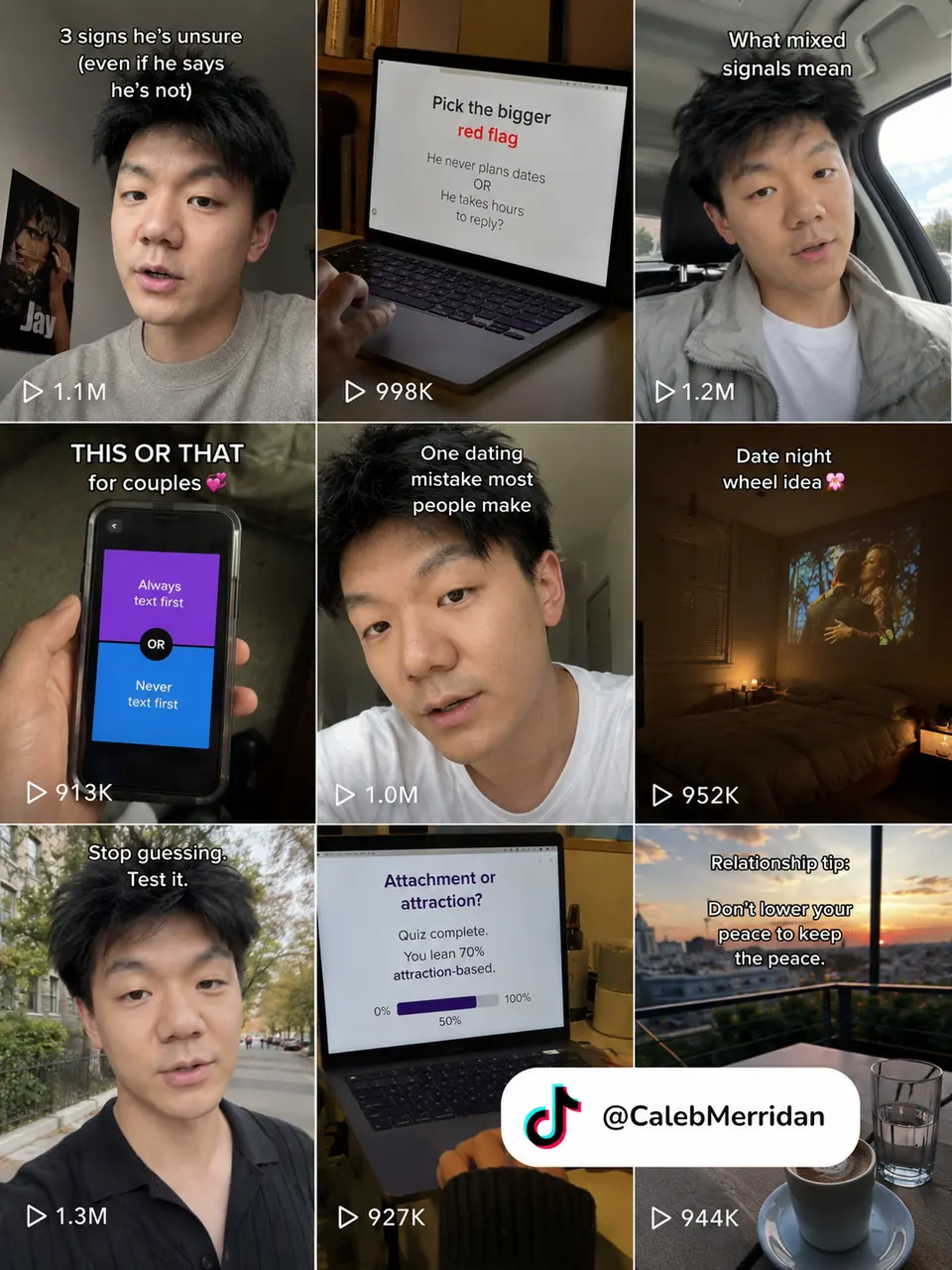
Before Caleb Merridan became a library of quizzes and games, I was already sharing relationship ideas through short videos, carousel posts, and simple advice content.
The same topics kept coming back.
Mixed signals. Anxious waiting. Boring date nights. Friends who feel like more. Hard conversations that never start. The strange feeling of knowing something is off, but not knowing how to name it.
People saved those posts because they recognized themselves in them.
They shared them because someone else needed the words too.
Sometimes a short idea did more than explain a feeling. It gave someone a way to finally ask, "Is this happening to us?"
That response shaped the website.
Caleb Merridan is built from the questions people kept returning to. The ones that were too personal for a comment section, too small for therapy, but too important to ignore.
So the ideas became tools.
Quizzes to organize the pattern. Games to make the conversation easier to start. Guides to turn an unclear feeling into something you can say without making everything heavier.
User Feedback Themes
People usually come here for one small question. They stay when the question turns into a clearer conversation.
"It helped us talk without making it a big thing."
We started with a game because it felt easy. Then one answer surprised us, and suddenly we were talking about something we had both been avoiding.
"I stopped replaying the same moment."
The quiz did not tell me what to do. It helped me see why I was reacting so strongly, and what pattern I was actually afraid of.
"It felt lighter than asking everyone for advice."
I liked that I could use it privately first. By the time I brought it up, I had better words and less panic.
Play next


Frequently Asked Questions
How does the Deep Question Randomizer random card game work?
Draw one prompt from the pool, answer it, then draw again when you want a new angle.
Will Deep Question Randomizer repeat the same prompt?
It can happen over time, but the pool is built to keep rounds varied across light, revealing, and debate-friendly cards.
Can I play Deep Question Randomizer on my phone?
Yes. This random card game is built for mobile browsers, so you can play it on a phone, tablet, or desktop without installing an app.
Is Deep Question Randomizer free to play as a relationship game?
Yes. You can start this random card game in your browser without an account, payment, or credit spend.
Can I replay Deep Question Randomizer?
Yes. Restart the game to clear this run and answer again, especially if you want to compare a calmer answer with your first instinct.
Is Deep Question Randomizer relationship advice?
No. It is a game for reflection and conversation, not counseling, diagnosis, or a rule for what you should do next.